How Collagen Supplementation Increases Tendon Stiffness and Strength
Ingesting 15 to 30 grams of hydrolyzed collagen peptides with 500 mg of Vitamin C 30 to 60 minutes before training spikes circulating glycine, proline, and hydroxyproline. When mechanical loading creates fluid shear across active tenocytes, these circulating precursors accelerate extracellular matrix collagen synthesis and enzymatic cross-linking, resulting in greater tendon stiffness and rate of force development.
Tendons are living extracellular matrix structures composed primarily of type I collagen triple helices. Tenocytes, the resident fibroblasts within tendon tissue, sense mechanical load through membrane-bound integrins.
Tensile stress causes fluid movement through the pericellular space, signaling tenocytes to upregulate collagen gene expression. Without sufficient circulating amino acids during this strain window, signal transduction yields minimal collagen accretion. Hydrolyzed collagen peptides supply the precise amino acid profile required to assemble new collagen alpha chains.
Coinciding mechanical strain with targeted amino acid availability aggregates new collagen fibrils into larger bundles, increasing total cross-sectional area over weeks of progressive loading. A thicker, denser tendon exhibits a higher Young's modulus, resisting deformation under extreme loads.
According to a 2023 systematic review in Nutrients, targeted collagen ingestion before exercise significantly enhances circulating amino acid availability and accelerates collagen synthesis in connective tissues. This structural stiffening optimizes force transmission directly to the skeletal system.
What Is the Precise Timing and Dosage Protocol for Tendon Collagen Synthesis?
Targeting connective tissue requires a different nutritional strategy than maximizing skeletal muscle protein synthesis. Skeletal muscle relies on prolonged intracellular signaling through mTORC1, driven by hyper-aminoacidemia and optimal leucine thresholds for muscle protein synthesis spaced every 3 to 5 hours.
Connective tissue relies on a precise vascular window where blood amino acid levels peak during fluid movement within the extracellular matrix. Consuming 15 to 30 grams of hydrolyzed collagen with 500 mg of Vitamin C 30 to 60 minutes prior to exercise aligns peak plasma levels with training. Plasma concentrations of glycine and hydroxyproline peak approximately 45 minutes post-ingestion, forcing amino acids into the avascular interior of the tendon during loading.
If collagen is ingested post-workout, mechanical strain has ceased and tenocyte mechano-sensitivity drops back to baseline. Fluid shear no longer drives precursor transport into the matrix.
Biomechanical Parameter | Tendon Matrix Adaptation | Skeletal Muscle Hypertrophy |
|---|---|---|
Primary Target Matrix | Extra-cellular Type I Collagen | Intracellular Myofibrillar Protein |
Vascularity & Delivery | Low (Avascular fluid shear required) | High (Direct capillary perfusion) |
Primary Anabolic Trigger | Mechanical strain & fluid shear | mTORC1 activation & amino acid sensing |
Key Amino Acid Drivers | Glycine, Proline, Hydroxyproline | Leucine, Isoleucine, Valine |
Optimal Nutrient Window | 30–60 min pre-workout spike | 3–5 hour bolus distribution |
Required Co-Factor | 500 mg Vitamin C (Ascorbic Acid) | None (Caloric / Insulin sufficiency) |

Why Is Vitamin C Mandatory for Collagen Cross-Linking and Tendon Strength?
Amino acid availability alone cannot produce a functional tendon matrix. Type I collagen strands require triple-helix stabilization through covalent cross-linking before they withstand heavy tensile forces.
This cross-linking process depends on two specific enzymes inside the endoplasmic reticulum: prolyl 4-hydroxylase and lysyl hydroxylase. These enzymes convert proline and lysine residues into hydroxyproline and hydroxylysine, which form structural hydrogen bonds and covalent inter-fibrillar cross-links.
Both hydroxylase enzymes require Vitamin C as an essential electron donor to maintain their active iron atom in its reduced ferrous oxidation state. Without 500 mg of co-administered Vitamin C, lysyl hydroxylase oxidizes to its inactive ferric state, preventing structural cross-linking and leaving new collagen vulnerable to degradation under load.
A meta-analysis in a 2023 systematic review in PMC confirmed that combining collagen peptide supplementation with Vitamin C increases engineered tissue synthesis rates compared to isolated loading. High systemic metabolic demands can divert dietary amino acids, so athletes can calculate baseline energy needs with our TDEE calculator to ensure adequate energetic headroom for tissue repair.
How Does Pre-Exercise Collagen Timing Improve Rate of Force Development?
Rate of Force Development measures how fast an athlete generates force within the first 100 milliseconds of muscle contraction. Motor unit recruitment velocity dictates neural drive, but tendon stiffness determines how rapidly force reaches the skeleton.
A compliant tendon absorbs initial sarcomere shortening and delays joint torque. Targeted collagen timing drives enzymatic cross-linking, which stiffens the extracellular matrix and enables instantaneous force transmission.
Higher stiffness reduces muscle fascicle shortening velocity during high-load movements, keeping muscle fibers operating near their optimal force-velocity relationship. This biomechanical adjustment directly enhances power output in heavy lifts and explosive jumps.
Athletes aiming to maximize neural drive alongside structural adaptations can combine this nutritional protocol with post-activation potentiation protocols. Managing heavy eccentric or isometric loads requires accurate load management; use our one-rep max calculator to determine precise intensity thresholds.
How Should You Integrate Connective Tissue Protocols Into Resistance Training?
Applying this protocol requires matching loading style with nutritional availability. Tenocytes do not require hours of continuous mechanical stimulation to trigger full collagen expression.
In vitro and in vivo studies indicate that 5 to 10 minutes of targeted loading—such as heavy isometric holds, high-impact jump rope, or heavy eccentrics—saturates tenocyte signaling. After 10 minutes of continuous strain, tenocytes become refractory to further mechanical stimulation for 4 to 6 hours.
Consuming collagen and Vitamin C 30 to 60 minutes before a brief 10-minute warm-up or dedicated isometric primer maximizes the adaptive signal. Extended high-volume sessions offer no additional collagen synthesis benefits and increase matrix breakdown if recovery nutrition is neglected.
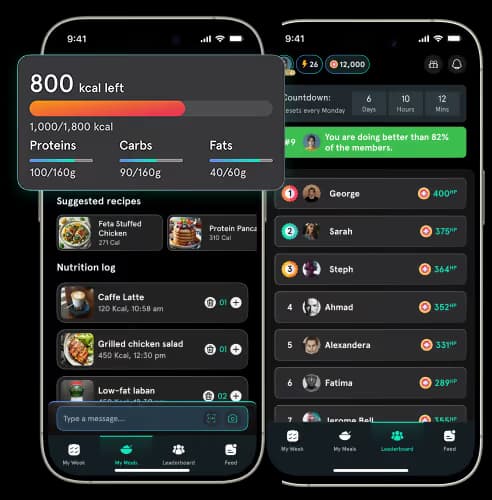
Managing daily protein targets alongside precise nutrient timing requires disciplined tracking. Using TrainMate for meal logging by photo, chat or manual entry allows you to log daily collagen and ascorbic acid doses alongside total daily macronutrients.
Structuring targeted tendon sessions requires organized workout management. You can schedule specific isometric warm-ups before heavy squat or bench days using TrainMate to build-your-own custom workouts saved to a personal library.
Tracking long-term strength gains alongside connective tissue adaptations requires precise session metrics. Athletes using TrainMate for guided gym workouts with set-by-set logging of reps, weight and assisted-machine loads can measure mechanical overload progression across training cycles.
Frequently Asked Questions
How long does it take for collagen supplementation to improve tendon stiffness?
Tendon remodeling occurs slower than skeletal muscle adaptation due to low tissue vascularity. Significant improvements in tendon cross-sectional area, structural stiffness, and rate of force development require 8 to 12 weeks of consistent pre-workout collagen ingestion paired with high-tensile loading protocols.
Can I take collagen with my whey protein shake instead of taking it separately?
Combining collagen with whey protein is suboptimal for targeted tendon synthesis. Whey contains high leucine concentrations that prioritize skeletal muscle protein synthesis via mTORC1. Taking collagen separately 30 to 60 minutes before brief loading protocols maximizes glycine and proline concentration in the extracellular matrix.
Is 500 mg of Vitamin C necessary, or can I rely on my daily multivitamin?
A dose of 500 mg of Vitamin C ingested simultaneously with collagen guarantees peak plasma ascorbic acid when hydroxylase enzymes are active. A standard multivitamin taken hours away from exercise fails to deliver the acute ascorbate concentration required to drive lysyl hydroxylase cross-linking during peak amino acid availability.
What type of exercise best stimulates tendon collagen synthesis after taking collagen?
High-tensile strain activates tenocyte signaling most effectively. Heavy isometric holds held for 30 to 45 seconds, slow eccentric loading at 70% to 85% 1RM, or dynamic plyometric jumps performed for 5 to 10 minutes generate the matrix fluid shear required to drive tenocyte amino acid uptake.
Building durable tendons requires pairing precise nutrient timing with progressive mechanical overload. TrainMate tracks your exercise execution, nutrient intake, and loading parameters so you never waste a training stimulus. Download the app to refine your training protocol and build connective tissue built for heavy output.